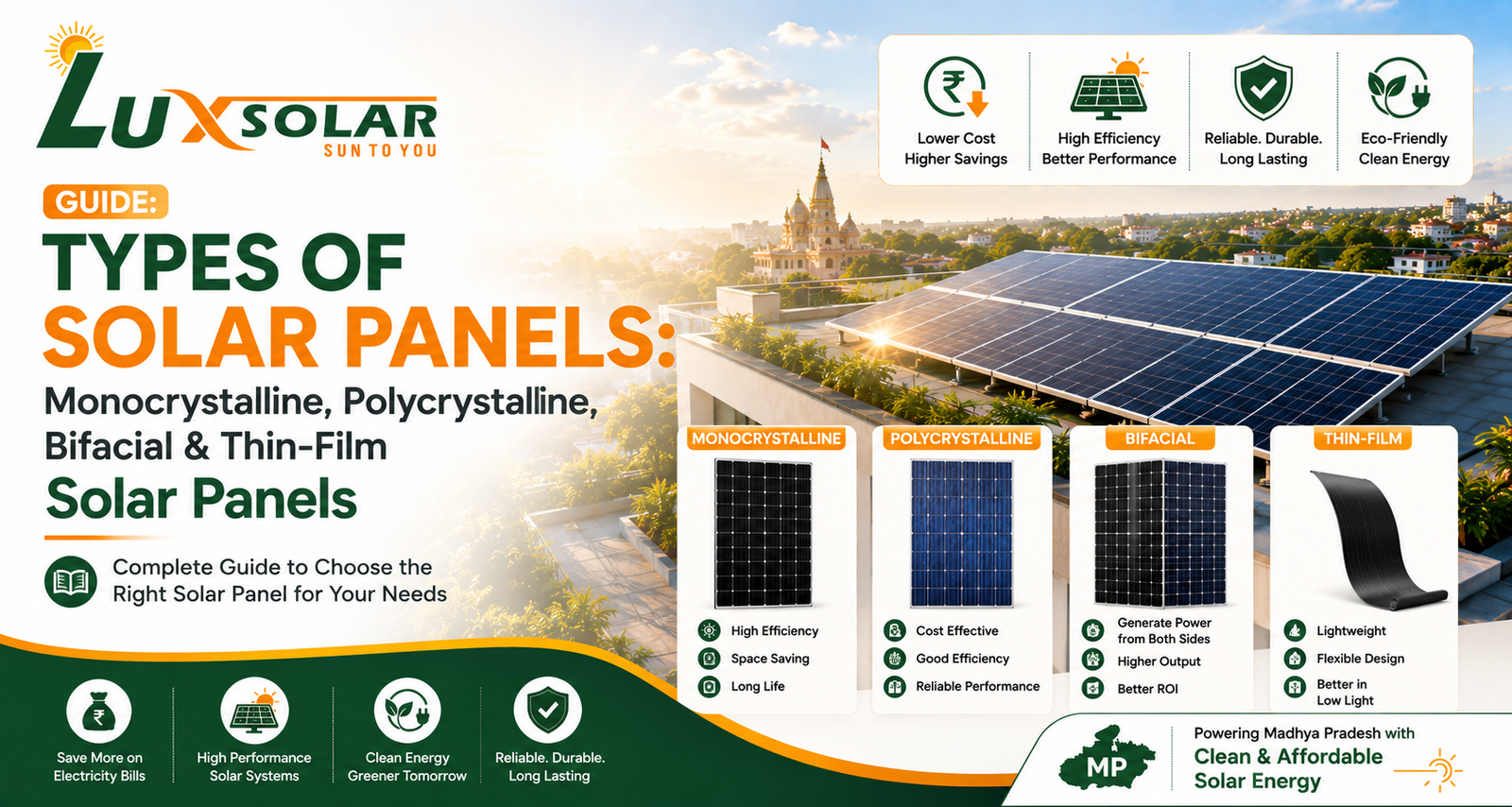
Guide: Types of solar panels: monocrystalline, polycrystalline, bifacial & Thin-Film Solar Panels
Selecting the right solar panels for your roof can feel like choosing a smartphone—there are dozens of specs, but what actually matters for your daily life? If you are scouting for solar panels in Jabalpur, you are likely trying to balance the intense summer heat with the need for long-term durability.
In 2026, the technology has shifted significantly. While old-school blue panels used to be the norm, new high-efficiency designs are taking over. Let’s break down the three heavyweights of the solar world: Monocrystalline, Polycrystalline, and the game-changing Bifacial panels.
1. Monocrystalline Solar Panels: The High-Performance King
Monocrystalline panels are the “premium” choice. They are made from a single, pure crystal of silicon. You can easily spot them by their sleek, dark black color and rounded edges.
- Efficiency: Highest (usually 20% to 24%).
- Space: Best for small roofs because you need fewer panels to generate the same power.
- Performance: They perform better in low-light conditions and handle heat better than older tech.
2. Polycrystalline Solar Panels: The Budget-Friendly Classic
Polycrystalline panels are made by melting many silicon fragments together. They have a distinct blue, marbled look. While they were the industry standard for a decade, they are slowly being phased out by more efficient technologies.
- Efficiency: Lower (usually 15% to 17%).
- Space: You need a larger roof area to match the output of a monocrystalline system.
- Performance: They tend to lose more efficiency when the temperature in places like MP hits 45°C.
3. Bifacial Solar Panels: The Modern Powerhouse
As the name suggests, “Bifacial” means two-faced. These panels have solar cells on both the front and the back. They capture direct sunlight on the top and reflected light (albedo) from the roof or ground on the bottom.
- Efficiency: Can be up to 30% more efficient than monofacial panels if installed on reflective surfaces.
- Durability: Usually dual-glass, making them incredibly tough against high winds and rain.
- Best Use: Ideal for “high-rise” structures where there is space for light to bounce underneath the panels.
Side-by-Side Comparison
Feature | Monocrystalline | Polycrystalline | Bifacial |
Color | Sleek Black | Shimmering Blue | Clear/Black (Dual Glass) |
Space Efficiency | High | Low | Very High |
Temperature Tolerance | Excellent | Average | Excellent |
Initial Cost | Moderate-High | Lowest | Highest |
Best For | Residential Roofs | Large Open Fields | High-Rise Structures |
When Does Thin-Film Make Sense? (The Lux Solar India Insight)
At Lux Solar India, when we do solar panel installations in Jabalpur, we rarely recommend thin-film for a standard RCC roof in Jabalpur because space is usually a constraint, and the high heat of Central India favors the durability of crystalline silicon. However, thin-film is a “problem solver” in specific scenarios:
Weight-Sensitive Roofs: If you have an old tin shed or a structure that cannot support the weight of heavy glass panels and GI mounting structures, thin-film is the only viable option.
Aesthetic Integration: For luxury villas in areas like Vijay Nagar where the owner wants the solar panels to look like part of the building’s facade (Building Integrated Photovoltaics or BIPV), Lux Solar India can source specialized thin-film modules.
Portable Power: Because they can be flexible, thin-film technology is often used for portable solar chargers or small off-grid setups for camping.
While thin-film is fascinating, Lux Solar India generally steers residential clients toward Monocrystalline or Bifacial modules to ensure they qualify for the maximum government subsidy and get the fastest possible return on their investment.
Which One is Right for You? (The Lux Solar India Perspective)
Choosing the “best” panel isn’t about finding the most expensive one; it’s about what works for your specific home. At Lux Solar India, we’ve observed that the Jabalpur climate presents a unique challenge: intense heat combined with heavy monsoon dust.
For most residential customers, Lux Solar India recommends Monocrystalline PERC or TOPCon panels. Why? Because the space on a standard residential roof is limited. By using higher-efficiency black panels, you can fit a 5kW system in the same space that would only hold a 3kW polycrystalline system.
If you are building a solar pergola or a raised parking shed, Lux Solar India often suggests Bifacial panels. By painting the roof surface white under the panels, the “albedo” effect can boost your energy generation by up to 15% without adding more panels.
Frequently Asked Questions (FAQs)
- Are black panels (Monocrystalline) really better than blue ones (Polycrystalline)?
Yes, in almost every technical metric. They last longer, look more aesthetically pleasing on modern homes, and produce more electricity during the early morning and late evening hours.
- Is it worth paying the extra cost for Bifacial panels?
It depends on the installation. If the panels are mounted flat against a dark roof, the “back” side won’t see any light, and you’re wasting your money. However, if they are on a raised structure, the extra power they generate pays for the price difference within 2-3 years.
- Do Polycrystalline panels still qualify for the government subsidy?
Yes, as long as they are ALMM-approved and Made in India. However, many top-tier manufacturers have shifted their production lines entirely to Monocrystalline, so Polycrystalline is becoming harder to find.
- Which type handles the Jabalpur heat the best?
Monocrystalline and Bifacial panels generally have a better “temperature coefficient.” This means as the panels get hot, their power output drops less than that of a Polycrystalline panel.
- How do I know which type Lux Solar India is installing for me?
Lux Solar India provides a detailed datasheet for every component before installation. You will see the cell type, efficiency rating, and warranty details clearly listed in your quote.