
Solar Hybrid System
Solar Hybrid System in Jabalpur — The Best of Both Worlds, Engineered by Lux Solar
Still choosing between an on grid solar system and an off grid solar system? You do not have to. A solar hybrid system in Jabalpur gives you the financial benefits of grid-tied net metering and the energy security of battery backup — simultaneously, in a single integrated installation.
Lux Solar India is MNRE-certified solar energy company and licensed solar panel suppliers in Jabalpur delivering professionally designed hybrid solar systems for homes, businesses, hospitals, institutions, and industrial facilities across Madhya Pradesh. If you experience frequent power cuts but also want to reduce your electricity bill and earn net metering credits, the hybrid system is the most complete and future-proof solar solution available to you today.
Explore our related services:
- On Grid Solar System
- Off Grid Solar System
- Solar Panel Maintenance
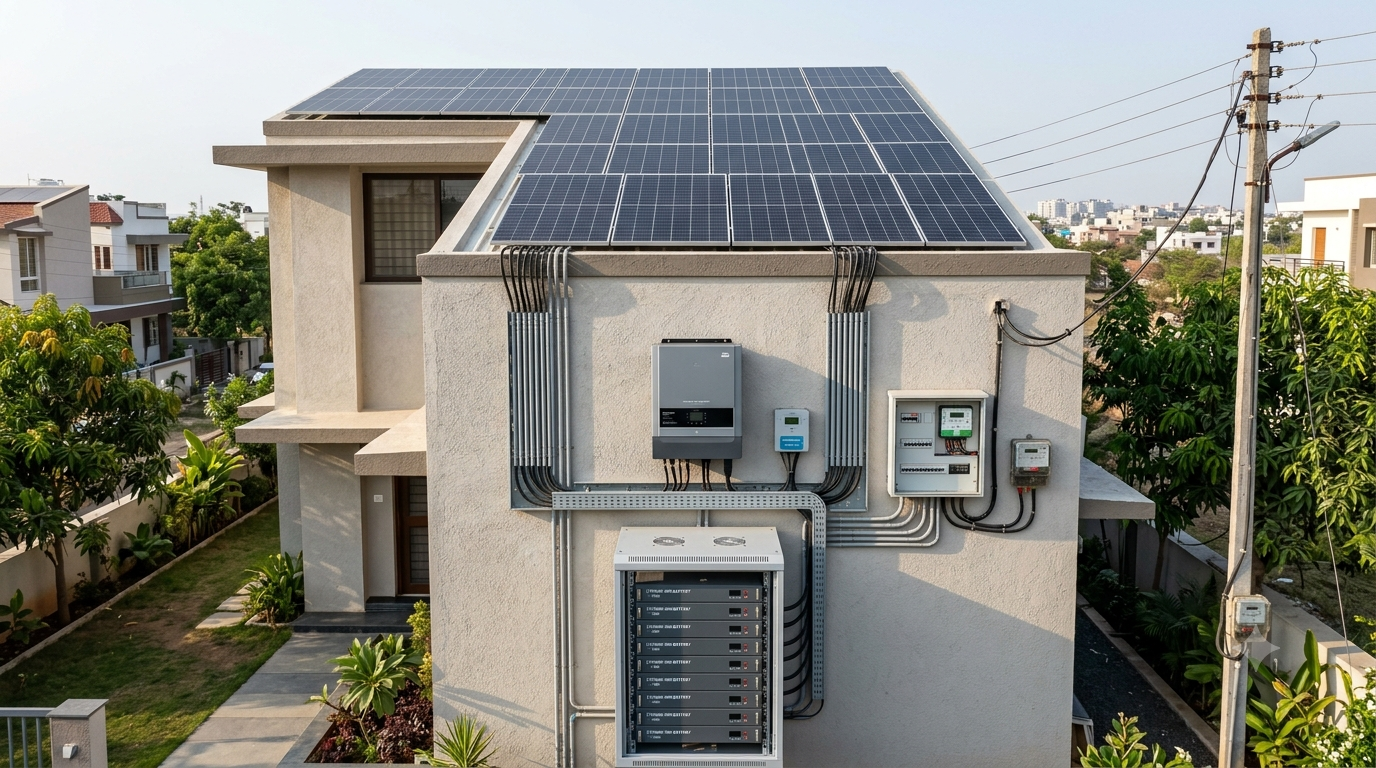
What Is a Solar Hybrid System?
A solar hybrid system is a photovoltaic energy solution that combines the architecture of an on grid solar system with the energy storage capability of an off grid system — into a single, intelligently managed installation.
In straightforward terms: your solar panels generate electricity during daylight hours. A hybrid inverter manages four simultaneous functions — powering your connected loads, charging your battery bank, exporting surplus to the JDVVNL grid through net metering, and drawing from the grid or battery when solar generation is insufficient.
The result is a system that never wastes generated energy, never leaves you in the dark during a power cut, and never forces you to choose between saving money and maintaining reliability.
A hybrid solar system combines all the benefits of on-grid electricity with the energy security and cost savings of an off-grid power solution. It is this dual capability that makes it the most sophisticated and increasingly the most popular solar configuration among urban homeowners and commercial establishments across India.
Lux Solar designs and commissions solar hybrid systems across Jabalpur, Katni, Mandla, Narsinghpur, and all districts of Madhya Pradesh — from compact 3 kW residential systems to large-scale commercial and industrial hybrid installations above 500 kW.
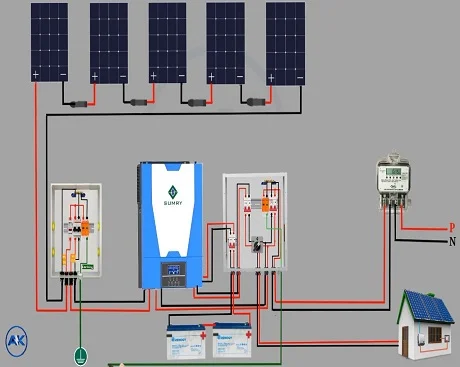
How Does a Solar Hybrid System Work?
The hybrid system’s intelligence lies in its control logic — managed by the hybrid inverter — which continuously monitors solar generation, battery state of charge, grid availability, and load demand, and optimizes energy flow across all four simultaneously. Here is the complete operational cycle:
Step 1 — Solar Generation Solar PV panels on your rooftop or ground structure produce direct current (DC) electricity during daylight hours. The hybrid inverter’s built-in MPPT charge controller extracts maximum power from the array regardless of temperature or partial shading conditions.
Step 2 — Priority Load Supply Solar power serves your premises first. Every watt generated by your panels offsets a watt that would otherwise be imported from the JDVVNL grid — reducing your electricity bill in real time.
Step 3 — Battery Charging Once your connected loads are served, the hybrid inverter directs surplus solar energy into the battery bank. The battery is charged to its programmed target state of charge — typically 90% to 100% — before any remaining surplus is exported to the grid.
Step 4 — Net Metering Export When both your loads are covered and your battery is at target charge, any remaining solar generation exports to the JDVVNL grid through the bi-directional net meter — earning you credits that offset your future nighttime import charges.
Step 5 — Battery Discharge at Night or During Power Cuts After sundown — or the moment JDVVNL supply fails — the hybrid inverter transitions automatically and instantly to battery power. There is no break in supply, no flicker, and no manual switching required. Your critical loads continue uninterrupted.
Step 6 — Grid Import for Remaining Night Load Once the battery reaches its minimum discharge threshold, the system draws the balance from the grid. The depth of this draw depends on your system sizing and battery capacity — a well-designed Lux Solar hybrid system minimizes this import to near zero for most residential customers.
Step 7 — Morning Solar Resumption At sunrise, the system seamlessly transitions back to solar priority mode — and the cycle repeats without any intervention.
Key Components of a Solar Hybrid System
Lux Solar sources, integrates, and commissions only MNRE-approved, Tier-1 components for every hybrid solar installation in Jabalpur. The system’s reliability depends entirely on the quality and compatibility of these six core elements.
Solar PV Panels
Lux Solar installs high-efficiency monocrystalline and bifacial solar panels from 400W to 550W per module, with 25-year linear performance warranties and certification under IEC 61215 and IEC 61730. Bifacial panels are particularly effective on elevated or ground-mounted structures in Jabalpur — capturing reflected irradiance from below in addition to direct sunlight, increasing annual yield by 8 to 15 percent.
Hybrid Inverter
The hybrid inverter is the central intelligence of the entire system. Unlike a standard grid-tie inverter that only manages grid export, or a standalone inverter that manages only battery loads, a hybrid inverter manages all four energy flows simultaneously — solar input, battery charging, grid interaction, and load supply. It contains a built-in MPPT charge controller and a transfer switch that activates battery power within milliseconds of a grid failure. Lux Solar installs single-phase hybrid inverters from 3 kVA to 20 kVA and three-phase hybrid inverters from 10 kVA to 100+ kVA depending on your load requirements.
Battery Bank
The battery bank determines your backup autonomy — how long your system can sustain your loads during a grid outage or at night without solar generation. Lux Solar offers two primary battery technology options for hybrid systems in Jabalpur:
Lithium Iron Phosphate (LiFePO4) batteries are the premium recommendation for hybrid systems. They support 4,000 to 6,000 deep charge-discharge cycles, allow up to 90% depth of discharge, require zero maintenance, and integrate seamlessly with hybrid inverter battery management systems (BMS). Over a 10-year lifecycle, they are more cost-effective per kilowatt-hour stored than any lead acid alternative.
Tubular Lead Acid batteries remain a proven, budget-accessible option for customers where upfront capital is the primary constraint. They provide reliable backup at 50% usable depth of discharge and require periodic water maintenance. Lux Solar recommends tubular batteries only where lithium is not feasible within the client’s budget envelope.
Battery Management System (BMS)
A Battery Management System monitors and protects the battery bank in real time — tracking cell voltage, temperature, state of charge, and charge-discharge current. It prevents overcharging, deep discharge, and thermal events, directly extending battery lifespan. In lithium battery packs, the BMS is integrated within the battery unit itself.
Bi-Directional Net Meter
A JDVVNL-approved bi-directional smart meter records units imported from the grid and units exported by your hybrid system independently — enabling net metering settlement on your monthly bill. Lux Solar manages the complete net meter application and activation process with the discom on your behalf.
Mounting Structure and Protection Equipment
All panel arrays are mounted on hot-dip galvanized or anodized aluminum structures engineered for Jabalpur’s wind load and monsoon conditions. DC junction boxes, surge protection devices, AC isolators, MCBs, and earthing systems are installed in compliance with CEA regulations and IS standards.
Remote Monitoring System
Every Lux Solar hybrid installation includes a cloud-connected monitoring system providing real-time data on solar generation, battery state of charge, grid import and export, and load consumption — accessible from your smartphone or computer from anywhere.
Benefits of a Solar Hybrid System in Jabalpur
Uninterrupted Power Supply — Even During Grid Failure
This is the defining advantage over a standard on grid system. When JDVVNL supply fails, the hybrid inverter switches to battery within milliseconds. Your lights, fans, refrigerator, computers, and critical equipment continue operating without interruption — invisible to you except for the silence where the power cut used to be.
Maximum Solar Self-Consumption
Unlike a pure on grid system that exports surplus to the grid at a feed-in credit rate, a hybrid system stores that surplus in batteries first — ensuring you consume your own cheapest energy (solar) before drawing from the grid at tariff rates. This maximizes the financial return on every kilowatt your panels generate.
Net Metering Credits Still Apply
Lux Solar hybrid systems are configured to export surplus to the JDVVNL grid after the battery reaches its target charge. You still earn net metering credits for exported units — combining storage savings with grid credit accumulation for the strongest possible bill reduction.
Protection Against Rising Electricity Tariffs
JDVVNL tariff rates have increased consistently over the past decade. A well-designed hybrid system reduces your grid import to a minimum — insulating the majority of your energy consumption from tariff escalation for the 25-year life of the solar panels.
Future-Ready Energy Infrastructure
hybrid system is the most expandable solar configuration available. You can start with a smaller battery bank today and increase storage capacity later as your budget allows or your energy requirements grow — without changing the inverter or panel array.
Ideal for Jabalpur's Power Situation
Many residential colonies, commercial areas, and industrial zones in Jabalpur experience 2 to 8 hours of power cuts daily — particularly during summer and monsoon seasons. A hybrid system is purpose-built for exactly this grid reliability profile, providing renewable solar generation combined with storage-backed continuity.
Reduced Carbon Footprint
A 5 kW hybrid solar system in Jabalpur offsets approximately 6 to 7 tonnes of CO2 emissions annually — the equivalent of removing a petrol vehicle from the road for a full year, every year, for the 25-year life of the system.
Solar Hybrid System vs On Grid vs Off Grid — A Clear Comparison
Understanding where the hybrid system fits relative to its two alternatives is essential for making the right investment decision.
On Grid Solar System Connects to the JDVVNL grid for net metering. No battery storage. Lowest upfront cost. Shuts down completely during power cuts. Best for locations with 24-hour reliable grid supply and minimal power cut exposure.
Off Grid Solar System No grid connection. Complete energy independence. Relies entirely on battery storage for nighttime and cloudy-day power. Highest upfront cost due to large battery bank requirements. Best for locations with no grid access or extremely unreliable supply.
Solar Hybrid System Grid-connected for net metering plus battery storage for backup and self-consumption optimization. Continues operating during power cuts. Balances upfront cost between on grid and off grid. Best for urban and peri-urban locations in Jabalpur where the grid is present but unreliable, and where both bill savings and power continuity are priorities.
For most residential and commercial customers in Jabalpur, the hybrid system represents the optimal balance of financial return, operational reliability, and long-term energy resilience. Lux Solar’s consultants will recommend the right configuration after evaluating your specific load profile, grid reliability history, and budget.
Solar Hybrid System Sizing — What Capacity Do You Need?
Sizing a hybrid system correctly requires balancing three variables: how much solar you need to cover daytime loads and battery charging, how much battery capacity you need to cover nighttime loads and power cut durations, and how large the inverter must be to manage peak simultaneous loads.
Lux Solar performs a detailed site assessment and load analysis for every customer before recommending a system design. The key parameters evaluated are:
Your total connected load in watts and the daily operating hours of each appliance — giving your daily energy consumption in kilowatt-hours.
Your critical loads — the appliances that must remain operational during a power cut — versus your non-critical loads that can be shed during battery operation.
The average daily power cut duration in your specific area of Jabalpur, which determines the minimum battery bank capacity required.
Your available rooftop or ground area for panel installation, which determines the maximum solar generation capacity of the system.
A practical reference benchmark for a medium-sized residential hybrid system in Jabalpur: a household consuming 20 to 25 kWh per day with 4 to 6 hours of daily power cuts and critical loads of 1.5 to 2 kW (lights, fans, Wi-Fi, refrigerator, select plug points) would typically be served by a 5 kW hybrid inverter, a 5 kW solar panel array, and a 10 kWh to 15 kWh battery bank — providing approximately 6 to 8 hours of backup on a fully charged battery.
For commercial and industrial hybrid systems in Jabalpur, three-phase hybrid inverters from 10 kVA to 100+ kVA are matched with larger battery banks and panel arrays through a formal engineering design process — covering power quality requirements, harmonic distortion limits, and demand charge optimization.
Government Subsidies and Tax Benefits for Hybrid Solar in Jabalpur
PM Surya Ghar Muft Bijli Yojana (Residential) Residential consumers in Jabalpur installing a hybrid solar system with rooftop panels are eligible for the central government subsidy under the PM Surya Ghar scheme — 40% for system capacity up to 2 kW and an additional 20% for capacity between 2 kW and 3 kW. The subsidy is disbursed directly to your bank account after post-installation inspection by the discom. Lux Solar manages the complete application process.
Accelerated Depreciation (Commercial and Industrial) Commercial entities, companies, and MSMEs installing hybrid solar systems can claim 40% accelerated depreciation on the full system investment under Section 32 of the Income Tax Act — significantly improving the post-tax internal rate of return in the first year of installation.
5% GST on Solar Equipment Solar panels, hybrid inverters, and associated system components attract only 5% GST — compared to the standard 18% slab — reducing the total system cost for all customer categories.
Net Metering Policy — MPERC and JDVVNL Hybrid systems configured for grid export are eligible for net metering under the Madhya Pradesh Electricity Regulatory Commission framework. Lux Solar ensures every hybrid installation is correctly configured and registered for net metering from day one.
Why Choose Lux Solar for Your Solar Hybrid System in Jabalpur?
A solar hybrid system is the most technically complex solar configuration available — requiring precise engineering of four interdependent energy flows, seamless inverter-battery-grid integration, and a deep understanding of local grid behavior. The quality of the outcome depends entirely on the expertise of the installer.
MNRE-Empanelled with Jabalpur-Specific Experience Lux Solar holds full MNRE empanelment and has executed hybrid installations across residential, commercial, and institutional segments in Jabalpur and Madhya Pradesh. We understand local grid characteristics, JDVVNL net metering processes, and the seasonal irradiance patterns that determine system performance.
Engineering-First System Design Every Lux Solar hybrid system is designed from actual load data — not from standard packages. We model your daily generation, storage, and grid interaction cycle to ensure the system delivers the savings and backup duration promised, not approximated.
Direct Solar Panel Dealer in Jabalpur for Tier-1 Brands As an authorized solar panel dealer in Jabalpur for leading Tier-1 panel and inverter manufacturers, Lux Solar sources genuine, fully warranted components at scale. Every component on your installation is traceable, registered, and covered by manufacturer warranty.
Complete Solar Panel Installation in Jabalpur — No Subcontracting From site survey through structural design, civil work, electrical wiring, battery commissioning, monitoring activation, and net meter application — every phase is executed by Lux Solar’s in-house certified engineering and installation team.
Post-Commissioning AMC and Remote Monitoring Lux Solar’s annual maintenance contracts cover hybrid inverter health checks, battery performance assessment, panel cleaning, monitoring system review, and on-site response within 24 hours for any fault condition in Jabalpur. Your hybrid system is a long-term asset — we treat it accordingly.
Frequently Asked Questions — Solar Hybrid System in Jabalpur
What is the main difference between a hybrid solar system and a regular on grid system?
A standard on grid solar system shuts down completely during a JDVVNL power cut — it has no battery and no backup capability. A hybrid solar system adds a battery bank and a hybrid inverter that switches to battery power within milliseconds of a grid failure, keeping your critical loads running uninterrupted. Both systems connect to the grid and earn net metering credits, but only the hybrid continues working when the grid goes down.
Will a solar hybrid system work during a power cut in Jabalpur?
Yes — this is its primary advantage over a standard on grid system. The moment the JDVVNL grid fails, the hybrid inverter automatically transfers your critical loads to battery power in under 20 milliseconds. There is no break in supply. The duration of backup depends on your battery bank capacity and the loads connected — Lux Solar sizes this specifically around your power cut patterns and critical load requirements.
Can I add a battery to my existing on grid solar system to make it a hybrid?
In many cases, yes — but it depends on your existing inverter. If your current inverter is a standard grid-tie inverter without hybrid capability, it cannot directly manage battery storage. Lux Solar will assess your existing installation and recommend the most cost-effective upgrade path — which may involve replacing the inverter with a hybrid model or adding an AC-coupled battery system compatible with your current setup.
How much does a solar hybrid system cost in Jabalpur?
System cost depends on panel capacity, inverter kVA rating, battery technology, and battery bank size. As a general benchmark, a 3 kW residential hybrid system with lithium battery backup in Jabalpur typically ranges from ₹2.5 lakh to ₹4 lakh before applicable subsidies. A 5 kW system with larger battery capacity ranges from ₹4 lakh to ₹7 lakh. After PM Surya Ghar subsidy and GST advantages, the effective cost reduces significantly for residential customers. Lux Solar provides a detailed itemized quotation after the free site assessment — with no hidden charges.
Is net metering available for a solar hybrid system in Jabalpur?
Yes. A solar hybrid system can be configured for JDVVNL net metering, and Lux Solar sets up every hybrid installation to do exactly that. Your hybrid inverter exports surplus solar generation to the grid after the battery reaches its target charge, earning net metering credits on your monthly bill. These credits offset your nighttime grid import charges — combining battery savings with grid credit accumulation for the maximum possible reduction in your electricity bill.
How long does it take to install a solar hybrid system in Jabalpur?
Physical installation of a residential hybrid system typically takes 3 to 5 working days. The complete timeline from signed agreement to net meter activation — including JDVVNL inspection and meter commissioning — is generally 35 to 50 days. Lux Solar's coordination team manages all discom-facing processes and actively follows up to minimize delays at every stage.